Offerwall Monetization: How Publishers Earn More from Rewarded Users

Offerwall Monetization: How Publishers Earn More from Rewarded Users
What is offerwall monetization?
Offerwall monetization is a way for apps, games and websites to earn from users by letting them choose tasks (install an app, reach a game level, start a subscription, finish a survey) in exchange for an in-app reward. The advertiser pays when the task is done. The publisher takes a share, and the user gets coins, lives or premium content.
Most of your users will never buy anything. That's normal. An offerwall gives them a way to "pay" with an action instead of a card, and it pays you for users who would otherwise bring in nothing beyond an occasional ad impression.
And because the user picks the offer, it doesn't feel like an ad break. Nobody gets interrupted mid-level.
How an offerwall works
Four main parties, one exchange:
- The user opens the wall. They usually open it from an in-game store, a reward center or at the moment they run out of lives.
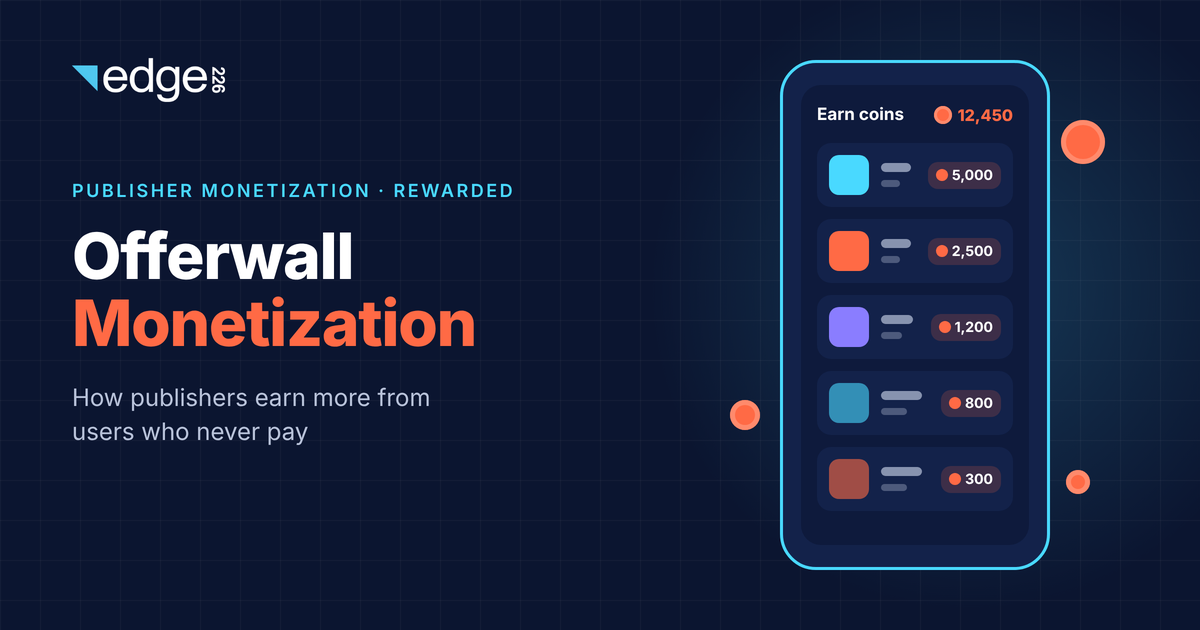
- They pick an offer. Each one lists the task and the reward, for example: install a finance app and open an account for 5,000 coins.
- They complete it. The advertiser's measurement partner confirms the action happened.
- Everyone gets paid. The advertiser pays the offerwall provider, the provider pays the publisher, and the user's reward lands in their account.
The simplest offers are "install and open." The better-paying ones are multi-step: reach level 10, complete a first deposit, keep a subscription past the trial. Those usually pay more because a deeper action is worth more to the advertiser. The reward itself can also bring users back: spending the currency they earned extends sessions in your app (Adjust; Edge226).
It isn't only an app format, either. Google made its own Offerwall generally available in Google Ad Manager in June 2025, after testing with more than 1,000 publishers. It works a little differently: site visitors watch a short ad, answer a survey or make a micropayment to unlock content. Google said at launch that publishers using it had seen an average revenue uplift of 9% (Google).
Offerwall vs rewarded video vs interstitials
You don't have to pick one. Plenty of apps run an offerwall next to rewarded video and use interstitials sparingly. They do different jobs:
OfferwallRewarded videoInterstitialWho starts itThe userThe userThe appWhat the user doesCompletes a task (install, level, sign-up, purchase)Watches a short video adSits through or closes an adHow the publisher earnsPer completed actionPer impression (eCPM)Per impression (eCPM)Revenue per engagementOften the highest, but fewer users engageLower per view, many users engageVaries, per impressionEffect on experienceLow, user-chosenLow, user-chosenHighest risk of annoying usersBest forUsers who want a big reward and have timeQuick top-ups (an extra life, a 2x bonus)Natural breaks between levels or articles
The pattern to notice: rewarded video gives you volume, the offerwall gives you value per user. A player who watches three videos a day for a few extra coins is a good user. A player who installs a finance app and opens an account through your wall can be worth more than dozens of those views.
How to earn more from an offerwall
The wall itself is rarely the problem. Where it sits and what it pays out usually are.
- Put the entry point where the need is. A wall buried in a settings menu gets almost no traffic. A wall offered at the moment a player runs out of lives, or next to the store when they can't afford an item, gets used.
- Price your currency so offers feel worth it. If an offer that takes 20 minutes pays the same as two rewarded videos, nobody does it. Check that your exchange rate makes the bigger offers look like a deal.
- Show offers your audience will actually finish. A casual puzzle audience and a fintech app audience want different things. Relevance drives completions, and completions are what you're paid on.
- Watch fraud as closely as revenue. Fake completions can be charged back, and advertisers stop buying from walls that send bad traffic. Ask any provider how offers are reviewed before launch and who monitors for anomalies.
- Track it in your MMP. Measure the users who engage with the wall on retention and lifetime value, not just wall revenue. If wall users stay longer (rewards often extend sessions), that's revenue the wall dashboard won't show you.
Edge226 and rewarded advertising
Edge226 acquired Adscend Media, a rewarded advertising company, in July 2025.
Adscend started as a content-locking platform and has run rewarded advertising for more than 15 years, working with publisher partners as well as its own apps and websites. Mobile games, subscription apps and fintech have consistently performed well, with growth in AI apps, personal finance tools and streaming platforms (Business Wire; Edge226).
What that means for a publisher:
- Demand from performance advertisers. Edge226 works with app and game advertisers who pay for outcomes such as installs and purchases, the kind of actions multi-step offers are built on.
- Quality checks before offers go live. Every offer is reviewed before launch, and a dedicated compliance team monitors for anomalies.
FAQ
What is an offerwall?
An offerwall is an in-app or on-site menu of tasks (app installs, game levels, sign-ups, surveys, purchases) that users complete in exchange for rewards such as virtual currency or premium content. Advertisers pay for each completed task, and the publisher earns a share.
Do offerwalls hurt user experience?
Less than most ad formats. The user chooses to open the wall and picks the offer, so nothing interrupts them. Interstitials, which the app triggers, carry more risk of annoying users.
Offerwall or rewarded video: which earns more?
Per engagement, usually the offerwall, because advertisers pay for completed actions. Rewarded video reaches more users. Running both covers users who want a quick top-up and users who'll put in time for a bigger reward.
Can websites use offerwalls, or only apps?
Both. Offerwalls are best known in apps and games, but web publishers use them too. Google Ad Manager's Offerwall, generally available since June 2025, lets site visitors watch an ad, answer a survey or pay a small amount to access content.
Add an offerwall to your app or site
If most of your users never pay, an offerwall is a direct way to earn from them without adding more ad breaks. Get in touch and we'll look at where a wall would fit in your app or site.