
Performance Marketing vs Brand Marketing: What’s the Difference?


Navigating the world of marketing can be complex, with many different strategies vying for attention. Among these, performance marketing and brand marketing often stand out as two critical yet distinct approaches. But what exactly do these terms mean, and how do they differ? More importantly, how can marketers leverage them effectively in tandem to achieve their goals?
What is Performance Marketing?
Performance marketing is a results-driven approach that emphasizes measurable outcomes. The success of this strategy is contingent on meeting specific, action-oriented objectives such as clicks, conversions, or purchases. Unlike other marketing tactics, performance marketing allows advertisers to pay only when a desired action is achieved.
Key Characteristics of Performance Marketing:
- Data-Driven: Relies heavily on analytics to track and optimize campaigns in real time.
- Action-Oriented: Focused on short-term, measurable results like leads, downloads, or purchases.
- Pay-for-Performance Model: Advertisers only pay when users complete a defined revenue-driven action.
- Highly Targeted: Performance marketing often uses precision targeting to reach the most relevant audience.
Common Strategies in Performance Marketing:
- Pay-Per-Click (PPC): Platforms like Google Ads allow businesses to appear at the top of search results and pay only for actual clicks.
- Affiliate Marketing: Collaborating with affiliates to promote products/services and paying them a commission for each sale they drive.
- Social Media Advertising: Platforms like Facebook and Instagram use hyper-targeting to drive instant engagement and results.
- Retargeting Campaigns: Focusing on users who visited your website but didn’t convert, with personalized ads to capture their attention.
Example:
Imagine a gaming app that wants to drive app installs. A performance campaign would target potential customers with install ads, measure the cost per install (CPI), and provide real-time feedback to optimize the campaign. With clear success metrics in place, advertisers would enjoy knowing they will only pay for the cost once a revenue-driven action is completed, like downloading the app or purchasing in-game add-ons.
What is Brand Marketing?
Brand marketing, on the other hand, is a long-term strategy aimed at building awareness, reputation, and emotional connections with a target audience. It seeks to establish trust and loyalty rather than driving immediate actions. Think of it as creating the foundation upon which other marketing efforts can thrive.
Key Characteristics of Brand Marketing:
- Emotionally Driven: Focuses on creating emotional bonds with the audience that leads to brand loyalty and ultimately referrals.
- Long-Term: Aims to influence how people perceive and interact with your brand over time - brand marketing strategies are not focused on quick wins, but rather delayed gratification.
- Broad Focus: Concentrates on storytelling, brand values, and identity rather than immediate results.
- Mass Appeal: Typically targets a broader audience to build widespread recognition.
Common Strategies in Brand Marketing:
- Content Marketing: Creating high-value blogs, videos, or case studies that align with your brand values and resonate with your target audience.
- Social Media Storytelling: Using platforms like Instagram or LinkedIn to showcase your brand’s personality, mission, and vision.
- Sponsorships & Partnerships: Sponsoring events or collaborating with influencers to enhance brand visibility.
- Public Relations (PR): Engaging with media outlets to build a consistent brand narrative.
Example:
Consider a consumer tech company launching a new product. Instead of driving immediate sales, a brand marketing campaign might focus on showcasing the company’s commitment to innovation through a series of emotionally resonant storytelling ads. The goal would be to create a rapport with the audience, deepening their ties to the company and increasing the likelihood of becoming a long-term, loyal consumer.
Performance Marketing vs Brand Marketing: The Key Differences
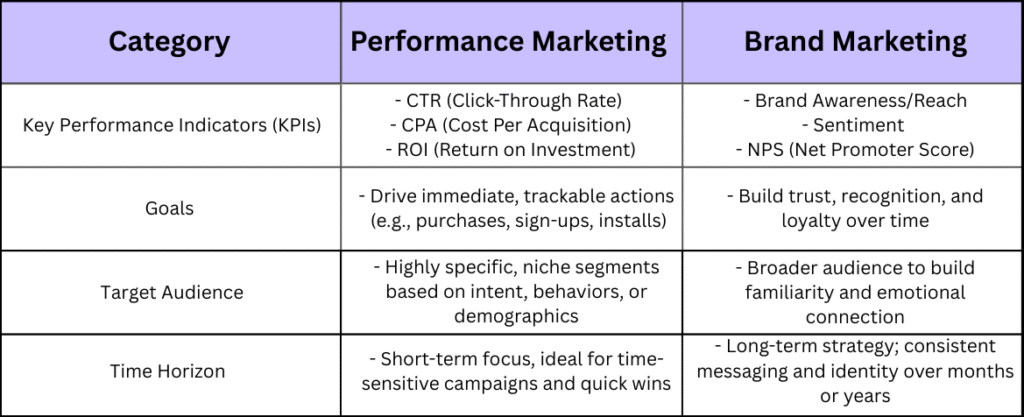
While both performance marketing and brand marketing are vital approaches, they serve different purposes. Here's a closer look at their key differences:
1. Key Performance Indicators (KPIs)
Performance Marketing:
Success is defined by direct, quantifiable actions that can be tied to revenue. Metrics are focused on efficiency and return.
- CTR (Click-Through Rate): Measures the effectiveness of ads in generating interest. A higher CTR often means the creative and targeting are resonating.
- CPA (Cost Per Acquisition): Tracks how much you’re paying for each conversion (purchase, sign-up, etc.). Lower CPA = better efficiency.
- ROI (Return on Investment): A top-line metric that evaluates whether the campaign is actually making money after costs.
Brand Marketing:
KPIs are more qualitative and long-term, capturing shifts in perception and mindshare.
- Brand Awareness: Gauges how well people recognize or recall your brand, often through surveys or impression-based metrics.
- Reach: Measures how many people saw your message, useful for assessing campaign scale.
- Sentiment Analysis: Evaluates how people feel about your brand (positive/negative/neutral) using social listening tools and customer feedback.
- Net Promoter Score (NPS): Indicates customer satisfaction and loyalty — a strong NPS means your brand is resonating deeply with your audience.
2. Goals
Performance Marketing:
The aim is to prompt immediate, trackable actions that contribute directly to business objectives.
- Think: driving a purchase, app install, email signup, or webinar registration.
- Campaigns are optimized for conversion, often through A/B testing, retargeting, and personalized messaging.
Brand Marketing:
Focused on shaping the identity and emotional resonance of a brand.
- Goals include building long-term loyalty, increasing positive associations, and creating a consistent voice in the market.
- It sets the foundation for trust and recognition that makes performance marketing more effective downstream.
3. Target Audience
Performance Marketing:
Audience targeting is hyper-specific and often data-driven.
- Marketers use demographic, behavioral, and interest-based data to segment and target users most likely to convert.
- Channels like paid search, social media ads, and display networks allow for precise targeting and retargeting.
Brand Marketing:
The audience is broader, aiming to generate recognition and favorability across a larger population.
- Messaging is designed to resonate emotionally and be memorable, even for those not in-market today.
- It helps establish a brand presence that makes future conversions easier when the need arises.
4. Time Horizon
Performance Marketing:
It’s about speed and short-term wins.
- Great for limited-time promotions, product launches, or hitting quarterly growth targets.
- Campaigns are often iterative and fast-paced, with frequent performance checks and adjustments.
Brand Marketing:
Built on consistency and long-term investment.
- Results compound over time — think increased brand recall, stronger customer affinity, and long-lasting equity.
- It may not always show immediate ROI, but it creates the groundwork for sustained growth.
The Power of Synergy: Integrating Performance and Brand Marketing
While performance and brand marketing serve distinct functions, combining them creates a holistic marketing strategy that drives both immediate results and sustainable growth.
Tips for Combining the Two Strategies:
- Leverage Brand Equity for Better Performance Results: A strong brand presence often leads to better CTRs and higher conversions in performance campaigns. Ensure your performance marketing aligns with your brand messaging for consistency.
- Use Performance Data to Inform Brand Strategies: The granular data from performance campaigns can provide insights into audience behavior. Use these insights to refine your brand messaging.
- Multi-Channel Approach: Use brand marketing to create demand and awareness across broad channels (e.g., TV, social media), then capture that demand with highly targeted performance marketing efforts (e.g., paid search or retargeting ads).
- Measure Holistically: Don’t look at only one set of metrics. While ROI is crucial, also assess long-term brand health metrics like brand recall or customer lifetime value (CLV).
Example of Synergy:
A new SaaS platform could use brand marketing strategies like thought leadership blogs and LinkedIn ads to introduce its mission of simplifying workplace productivity. Simultaneously, the company could run performance campaigns offering free trials to drive sign-ups. Together, these approaches form a powerful growth engine.
Why Both Matter in Modern Marketing
Both performance marketing and brand marketing are essential in the digital age. Focusing only on performance may boost short-term results but could miss building long-term loyalty. Conversely, focusing only on brand marketing might mean you’re influencing perceptions but not driving immediate action.
By understanding their differences and striking a balance between them, you can create a marketing strategy that positions your company for long-term success.


