CTV to Mobile Attribution: Why Your Installs Arrive Late and Land in Organic

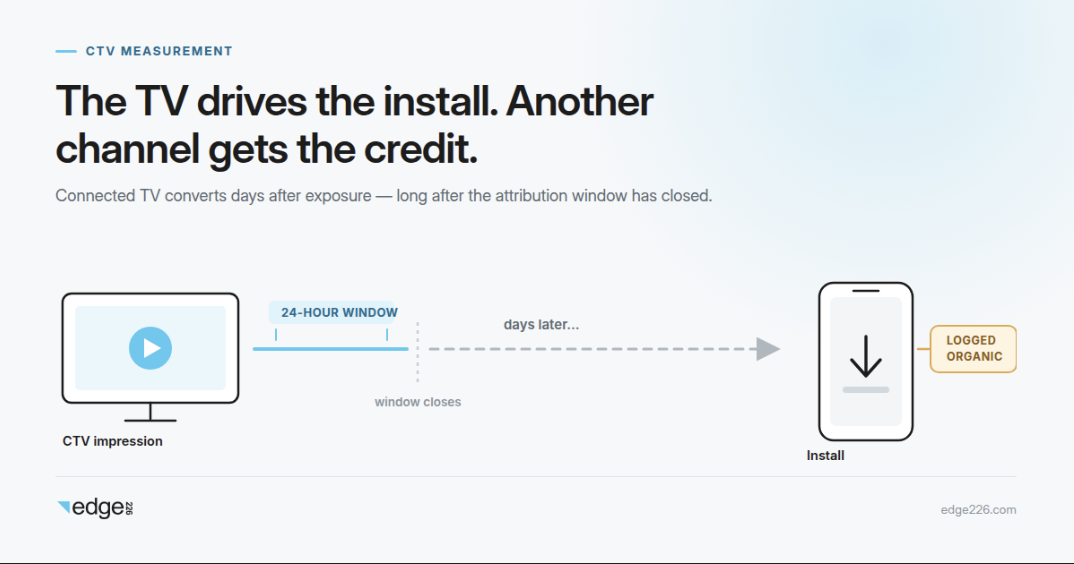
Someone sees your ad on television. They can't tap it, so nothing happens. They pick up their phone that evening, the next day, or the following weekend, and install it.
Mobile attribution was built to connect a tap to an install, and it's good at that. A connected TV (CTV) impression and a phone install days apart are a different problem, and understanding why it's difficult changes what you should do about it.
How CTV-to-mobile attribution works
CTV-to-mobile attribution commonly relies on IP addresses and other probabilistic signals to connect a CTV impression to a mobile install. Televisions can have their own advertising identifiers, but those identifiers generally can't be tied directly to the IDFA or GAID on a phone. The match is therefore probabilistic and often household-level, which is why mobile measurement partners (MMPs) rank it below clicks and device-ID matches when deciding who gets credit.
That ranking makes sense. An IP address shared by several phones in one household is weaker evidence than a click carrying a device ID. MMP documentation is candid: installs and reattributions often aren't credited to CTV impressions, even when the CTV ad influenced the journey.
The signal degrades by the hour
An IP-based match gets weaker quickly, and that decay explains everything downstream.
Household IPs can change when DHCP leases renew. Carrier-grade NAT can put thousands of unrelated subscribers behind a single address. The phone you're trying to match may leave the home network entirely when its owner goes to work. A match made two days after a CTV impression is a far weaker claim than one made the same evening, and MMP documentation is explicit that probabilistic match accuracy can decline sharply after the first 24 hours.
So cross-device attribution windows are short by design. Defaults commonly sit at 24 hours, and configurable ceilings can extend to a few days, not weeks. That isn't simply MMPs being cautious. It's the practical limit of what an IP address can tell you over time.
But CTV converts on a longer clock
Nobody installs during the ad break. They finish the episode, remember it the next morning, and search for the app then. There's no click available to shorten the gap because the screen carrying your ad can't accept one.
For whatever CTV volume you're already attributing, pull the time between the first CTV impression and the install. In many accounts, the curve stretches well past the first day.
That's the collision. IP matches become less reliable over time, while CTV-influenced conversions can continue arriving. Some share of your CTV-driven installs will therefore arrive after any defensible attribution window has closed, and those installs were never contested. Attribution logic only decides who wins a contested install, so no configuration change can recover them.
The gap isn't necessarily a setup mistake you can correct. It's a measurement challenge created by a channel that runs on one screen and converts on another.
Why CTV can show up as organic
An install arriving with no eligible touchpoint inside the attribution window can be recorded as organic. It appears as ordinary unattributed volume, quietly, in a line nobody questions.
You can look for the signature without changing anything: compare organic install share for the eight weeks before your CTV spend started against the eight weeks after.
Be honest about what that gives you, though. It's a hypothesis generator, not evidence. Seasonality lives in that delta, along with any ASO work, a store feature, and every other channel you were running. What it's good for is deciding whether the question deserves a real test.
The failure mode runs both ways, which is the part that costs money. Flat CTV-attributed installs sitting beside an unexplained organic lift often get interpreted as CTV cannibalizing organic, when the two may actually represent the same volume seen from different angles. One reading protects the budget. The other cuts it.
What to change, and what each change costs
Review your attribution window with your MMP. Most accounts run the default, commonly 24 hours. There's usually room to extend it. A wider window can improve recall for this channel, but it comes at the cost of precision. Treat the larger window as a hypothesis to validate, not a result to report.
If you raise CTV's attribution priority, tell your other partners first. This is the change with a bill attached. Extending a window usually doesn't move money because CTV inventory bills on CPM. Raising CTV's priority does: it can take attributed installs away from the CPI and CPA networks you pay per install, and those partners will notice.
Annotate the date. Attribution changes apply going forward only. Period-over-period comparisons can become difficult to interpret the moment you make a change, with nothing in the reporting marking why.
Ask about assist reporting. Instead of asking who wins the install, it asks whether CTV-exposed users behave differently. Do users who saw a CTV ad and later converted elsewhere spend more or retain better? MMPs offer different versions of this reporting, and your account team may need to configure it.
On iOS, the framework doesn't directly cover CTV
You can check this in Apple's own documentation. SKAdNetwork lists availability for iOS and iPadOS, while AdAttributionKit supports iOS. Neither framework provides a direct mechanism for attributing a CTV impression to an iOS app install. Both are built around supported in-app advertising flows, with SKAdNetwork also covering ads in Safari, rather than television impressions.
So for direct CTV-to-mobile attribution on iOS, measurement typically relies on probabilistic modeling and complementary approaches such as assist reporting and incrementality testing. If your measurement strategy is SKAdNetwork-first, be aware that the framework does not attribute CTV impressions to iOS app installs.
The method that settles it
Geo holdout testing sidesteps the attribution question because it never asks which touchpoint deserves credit. Suppress CTV in matched markets, run it in others, and compare total installs, organic included.
There's real work behind it. You need matched markets that survive scrutiny, enough spend in both cells to detect the expected effect, and enough time to account for normal variation and seasonality. Budget it as a project. Other incrementality methods exist, including media mix modeling, PSA holdouts, and synthetic control.
For many app advertisers, a geo holdout is a practical way to answer the question you're actually asking: not who deserves credit for an install, but whether the install would have happened at all.
Where to start
- Check what window your CTV campaigns run on. Don't assume the default is right for your campaign.
- Discuss extending it with your MMP, accepting that match quality can decline as the window grows.
- Warn your CPI and CPA partners before you change CTV's attribution priority.
- Annotate every change date where your finance team can reference it.
- Ask your account team about assist reporting, and what's available for your specific setup.
- Plan a geo holdout before any significant budget decision.
CTV can convert over a longer period than some probabilistic attribution windows are designed to reliably capture.
Configuration gets you a better measurement signal. Testing gets you the answer.
Whichever MMP you're on, several of the changes above aren't self-serve and may require your account team. Talk to us about your setup, and we'll walk through it with you.
FAQ
What is CTV-to-mobile attribution? Matching a CTV ad impression to a mobile app install. Because a connected TV and a mobile device generally don't share a common advertising identifier that enables deterministic matching, the connection relies on probabilistic signals such as IP address and is often household-level rather than device-level.
Why are my CTV installs showing as organic? An install arriving after the attribution window closes may have no eligible touchpoint and therefore be recorded as organic. CTV-influenced conversions can happen well after the initial exposure, so some volume may fall outside the attribution window.
How long should a CTV attribution window be? There isn't one universal answer. A longer window can capture more potential CTV-influenced conversions, but match confidence can decrease as the time between exposure and install increases. Set the window with your MMP based on your campaign and measurement goals, then validate the impact with incrementality testing where possible.
Can SKAdNetwork measure CTV campaigns? Not as a direct CTV-to-iOS attribution mechanism. Neither SKAdNetwork nor AdAttributionKit provides a direct way to attribute a CTV impression to an iOS app install. Both frameworks are built around supported in-app advertising flows, and SKAdNetwork also covers ads in Safari, not television impressions. CTV campaigns therefore require other measurement approaches, such as probabilistic cross-device attribution and incrementality testing.