3 Things Advertisers Should Look at When Measuring CTV

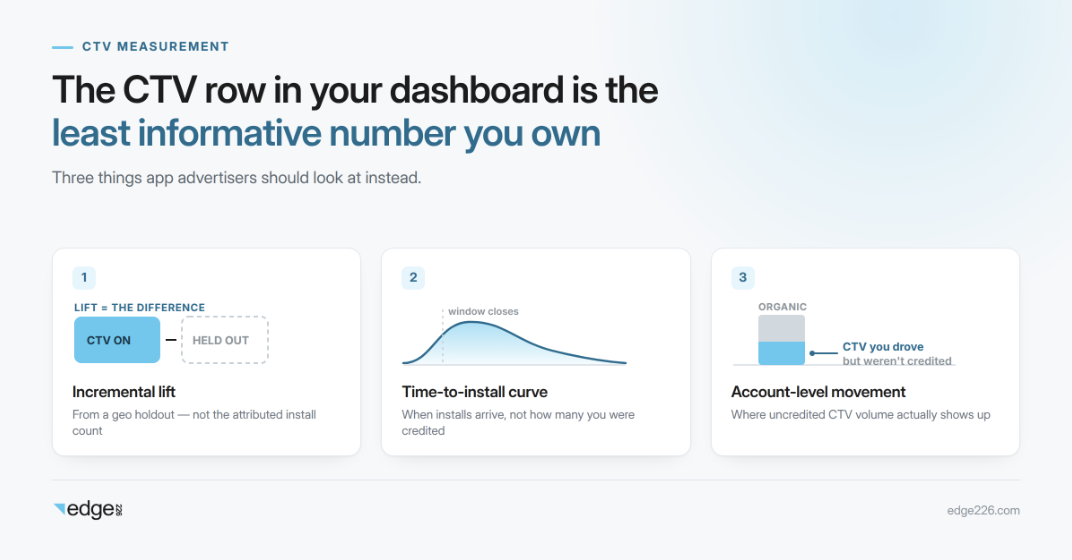
Open your mobile measurement partner (MMP) dashboard. Find the CTV row. Whatever number is sitting there, it's smaller than the truth, and you already suspect that.
Most CTV measurement advice written for app advertisers stops at explaining why. We've already covered the plumbing in our post on CTV-to-mobile attribution: a TV and a phone don't share an advertising identifier, so matching runs on household IP, probabilistically, inside a short window. Fine. That's the constraint. It isn't going away.
The interesting question is what you should actually look at once you've accepted that constraint. Not reach or frequency, and definitely not the CTV line in a last-touch report. Three things, in order of how much they'll change your decisions.
1. Incremental installs, measured with a geo holdout test
CTV measurement for app installs works best through incremental lift, not attributed installs. Hold CTV spend out of a matched set of markets, run for several weeks, then compare total install volume between held-out and exposed markets. It ignores attribution entirely and measures lift.
Here's why this beats the dashboard. Every attributed CTV install comes from a matching rule someone configured. Change the rule, change the number. Nothing about the user's behavior has changed. A geo test doesn't care about identifiers, windows, or match logic, because it never tries to connect an impression to an install. It compares two populations.
The mechanics are well documented. Google Research published the standard framing in Measuring Ad Effectiveness Using Geo Experiments: randomly assign non-overlapping regions to test and control, then measure the difference in total installs from every source, organic included. Later practice added matching markets on volume and seasonality, which you'll want for install data.
Now the part that never makes it into the intro paragraph. This costs money.
You are deliberately turning off spend in markets that are probably working, for weeks. You also can't optimize anything while the test runs, because optimizing mid-test invalidates it. If your monthly CTV budget is small, the lift you're trying to detect may sit below the noise floor of your own install volume, and you'll spend the money to learn nothing. Run the power calculation before you run the test. If the answer is that you'd need three months at triple the budget to detect a 5% lift, don't run it. Get to more volume first, then test.
One upside worth the effort: geo tests work identically on iOS and Android. No postback and no identifier to lose. That matters more than it used to.
2. How to read your time-to-install curve
Stop looking at how many CTV installs you got. Look at when they arrived.
Pull install-level data with timestamps, plot the gap between CTV impression and install, and read the distribution. It's the cheapest diagnostic in CTV, and most accounts never run it. Three shapes show up.
A hard spike in the first few minutes usually means second-screen behavior. Somebody saw the spot, picked up the phone, searched the app. That's genuine intent, and it's your strongest signal for which creative and which inventory are doing work.
A broad hump spread across hours or a couple of days means the response is real but slower than your measurement can see. Probabilistic IP accuracy decays sharply after roughly the first day, once DHCP leases renew and devices leave the home network. Cross-device windows commonly default to about 24 hours, and even the configurable ceilings run to days, not weeks. Anything living in the tail of that hump is being logged as organic, or credited to whichever paid source still has a window open. The curve tells you roughly how much.
A flat, featureless distribution is the bad one. If installs arrive at a uniform rate across the whole window with no relationship to impression time, you're mostly matching coincidence. Two devices on one household IP, no causal link. That's a signal to look hard at your inventory mix before you spend more.
What does this cost you? Not money. Time, and probably a favor. Most reporting UIs won't give you impression-to-install deltas at the row level, so you'll need a raw data export and somebody who can plot it. Budget an afternoon and one conversation with whoever owns your data warehouse.
The curve doesn't prove causality. It can't. But it tells you whether the geo holdout test in section one is worth running, and it gives you a rough size for the gap you're trying to price.
3. How CTV affects organic installs and blended CPI
CTV credit doesn't vanish. It gets filed somewhere else.
So watch the lines you'd never think to watch: organic installs, blended CPI across the whole account, and the install volume your existing CPI partners are reporting. If organic installs jump the week CTV launches and settle back when it pauses, that's your answer, and it's a better answer than the CTV row gave you.
This is sharpest on iOS. Apple's SKAdNetwork lists iOS and iPadOS; AdAttributionKit lists iOS 17.4. Neither lists tvOS, and both are built around an ad displayed inside an app, with SKAdNetwork also covering ads in Safari. A living-room TV impression has no postback path at all — not restricted, absent. Account-level movement is the only place that spend shows up.
Which brings up the setting everyone eventually asks about. Yes, you can raise CTV's attribution priority. MMP waterfalls typically rank engagements by evidence reliability: clicks before impressions, and within each, a verified device-ID match before a probabilistic one, as MMP documentation sets out. That's the correct engineering call, given that a click is a deliberate act and a device-ID match is verifiable. By construction, it also puts a probabilistic CTV impression on the bottom rung, one step above organic.
Before you touch it, understand the two prices. Attribution changes apply going forward only, so every period-over-period comparison you own breaks at the moment you flip the switch. And the installs CTV starts winning come out of somebody else's column. If those are CPI or CPA partners paid on the volume you're about to reassign, you've just cut their invoice, and they will notice. Have that conversation first, in writing, and include the effective date.
Our position: don't change the setting to make CTV look better. Change it once, deliberately, after a geo test has told you roughly how big the real effect is, so the new configuration is closer to the truth than the old one. Otherwise leave the waterfall where it is and do the modeling outside the platform.
Where to start with CTV measurement
CTV is measurable for app advertisers. It's just not measurable the way your other channels are, and the sooner you stop trying to force it into a last-touch report, the sooner it earns a permanent line in the budget. Test for lift. Read the curve. Watch the whole account. The IAB's Standardized Measurement Guide for CTV is a reasonable place to go next if you want your team working from shared vocabulary before you start.
FAQ
What is the best metric for measuring CTV campaigns?
Incremental installs from a geo holdout test. Attributed installs depend on configuration choices that vary by setup, so the same campaign can produce different numbers depending on how the waterfall is tuned. Lift measured against a held-out market doesn't move when settings change.
How long should a CTV geo holdout run?
Long enough for the lift you expect to clear the natural week-to-week variance in your install volume. Run the power calculation on your own historical data before committing budget. If your daily install counts swing 20% for no reason, a two-week test won't tell you anything.
Can you measure CTV-driven installs on iOS?
Not at the device level. Neither of Apple's attribution frameworks lists tvOS, and both are designed around ads served inside an app or a web page, never a TV screen. On iOS, you measure CTV through geo lift and account-level movement, which is also why iOS-heavy advertisers should build the testing habit earlier.
Should you raise CTV's attribution priority in your MMP?
Only after a geo holdout test has given you a sense of the true effect size, and only after you've told any partner you pay per install. The change isn't retroactive, and it breaks your historical comparisons, so make it once, not iteratively.
If you're buying CTV for app installs and the measurement side is where it keeps stalling, that's the conversation we have most often. Edge226 runs CTV and mobile UA on the same DSP, so we can review the account-level view in section three with you, not around you. Reach out if a second read on your setup would help.