Edge226 Solutions: Which One Solves Your Problem

Edge226 runs six solutions. Four of them are ways to buy users and two are ways to sell inventory, and the most common mistake is picking the one that matches your job title instead of the one that matches your problem.
This is a map of what each is for, where two of them overlap, and when the answer is that none of them fits.
If you are buying users
In-App. The default for most app advertisers: campaigns across global in-app inventory, priced and optimized past the install toward the event your product earns on, with KPIs running from CPC and CPI through CPA, ROAS and predicted lifetime value. This is the right starting point when your conversion happens inside your app and you can instrument it. If your success metric is still cost per install, the channel will deliver installs and you will learn nothing, which is a measurement problem, not a media one.
CTV. For reaching viewers on the big screen, with campaigns aligned to outcomes instead of impressions and optimized toward CPI, CPA, ROAS or retention. The thing to understand before buying it is that a television and a phone share no advertising identifier, so the connection is probabilistic and household-level, and your dashboard will undercount what the channel contributed. Our post on why CTV installs arrive late and land in organic explains what that does to a report, and the honest read on the channel is an incrementality test, not a campaign row.
Rewarded Advertising. Opt-in formats across offerwalls, surveys, rewarded video and display, where users engage in exchange for in-app currency, content access or premium features, across mobile and desktop. Pricing runs from CPL and CPI through CPA, CPE and multi-event structures, so you can pay against a step well down the funnel. Two things distinguish it from the rest of the lineup. The inventory includes owned and operated properties such as LootUp and PixelPointTV alongside vetted partner integrations, so some of what you buy is Edge226's own. And the reward gives the user a reason to complete a multi-step action that no targeting change can manufacture. It suits products with a verifiable deep event worth paying for, and it disappoints predictably when the event you price is an install. We went through how to pick that event in buying offerwall traffic that retains.
Direct. A set of distribution channels rather than a single buying route: direct integrations with individual apps, device-maker placements on device-level surfaces, alternative marketplaces, rewarded media, external platform integrations and performance media buying with real-time bidding. The case for it is access that does not depend on app store discovery or resold inventory, and a shorter path to the publisher.
Where two of these overlap. Rewarded media appears in the Rewarded solution and again as a Direct channel, which anyone comparing the two pages will notice. The difference both pages do carry is scope: Rewarded is a reward-format solution end to end, with its own formats, properties and pricing models, while Direct is a set of distribution channels of which rewarded media is one. If reward-based inventory is what you want, start with Rewarded. Direct is the answer when you want the other channels on that list as well.
If you are selling inventory
Marketplace. Supply for DSPs and programmatic buyers, built on direct publisher relationships, with in-app and CTV inventory and optimization toward CPM, CPI, CPA or ROAS. Two specifics are worth naming because a buyer can check them. Indirect supply is limited to one hop, which matters because each additional hop takes a margin and is another place inventory can be resold. And inventory is continuously monitored through a direct integration with HUMAN, which is a third party you can ask about.
Integration is by OpenRTB, a Prebid adapter or VAST, which means there is no bespoke engineering project before you can start.
Player. Video ad serving and monetization for publishers: a VAST-compatible audio and video player connecting multiple demand sources at once, with delivery caps and partner-level controls, sticky units that stay visible as the page scrolls, third-party tracking pixels, dynamic macros and configurable reporting. This is the one solution aimed at publishers monetizing their own content, rather than at anyone buying media. If you arrived here as an app marketer, it is not for you.
What ties the buying solutions together
Outcome-based pricing. Across all four buying solutions the intent is to price against results instead of impressions, from installs through in-app events, purchases and multi-event structures. What that genuinely changes is who carries the risk when a campaign underdelivers. What it does not change is measurement: an outcome you cannot verify is not safer to buy than an impression; it is just priced differently. The qualifying event has to be instrumented before the campaign starts or the pricing model is decorative.
One platform across channels. Running in-app, CTV, rewarded and direct through one platform means one commercial relationship and one optimization layer, which shifts spend toward the channels, audiences and placements performing best. What it does not give you is a number that means the same thing in every row, because a probabilistic household match and a server-confirmed reward event are not the same object. Judge each channel against its own criterion and use incremental lift as the shared measure.
The AnyClip acquisition, and what it is for
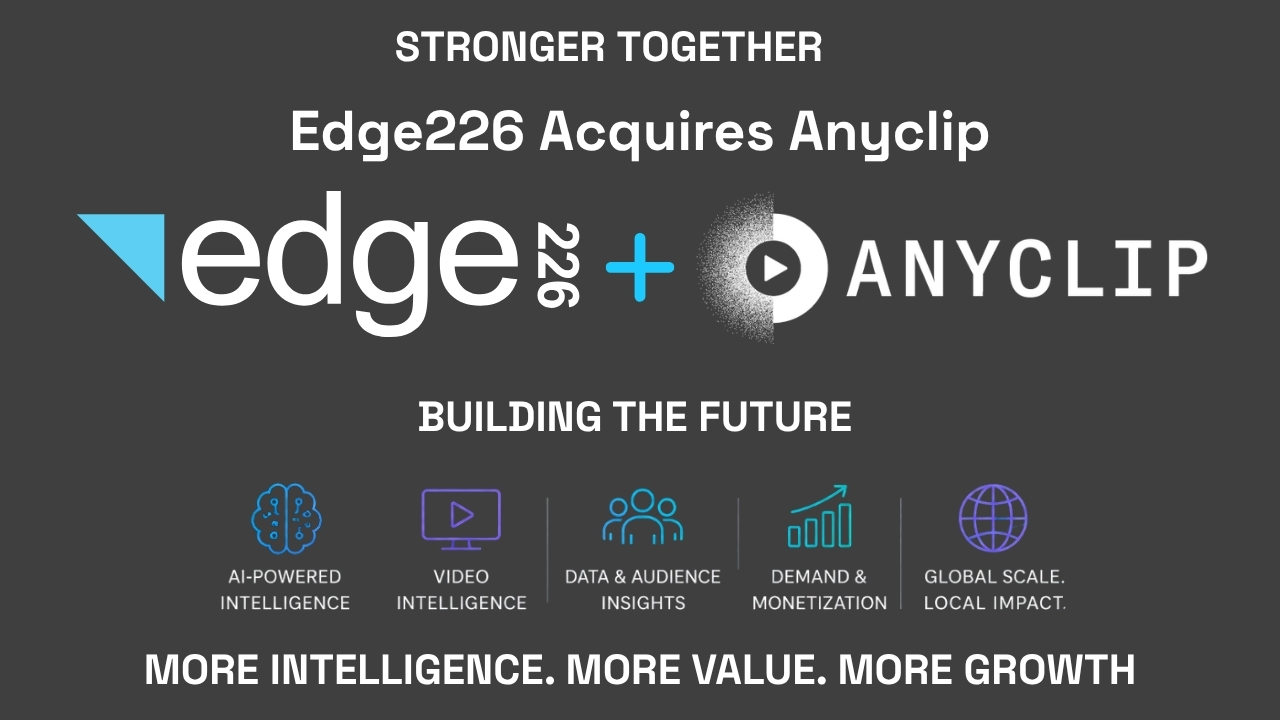
In July 2026 Edge226 acquired AnyClip, an AI-powered video intelligence company built for media companies and publishers. Its Video Intelligence Platform analyzes video content and returns detailed insight into what that content actually contains, which publishers have used to get more value out of existing video libraries.
What it adds on the advertiser side is context. Edge226 states the aim as combining that content intelligence with its own demand, audience data and measurement to deliver more contextual targeting without sacrificing performance, along with a clearer account of where a brand message appeared and alongside what content, across CTV, in-app, rewarded and desktop environments.
Read that as a capability being integrated across the solutions above, not a seventh product with its own page, and ask what is live today before planning a campaign around it.
When none of this is the answer
Four cases, because the alternative is a sales call that wastes an hour.
When your conversion event does not exist yet. Every solution above optimizes toward something. If the only event you can measure is an install, fix the instrumentation first; no channel choice compensates for it.
When you cannot run a test that would settle the question. If your markets are too few to randomize across, or if nobody internally will agree in advance that a test result outranks the dashboard, the channel gets judged on an attributed number that cannot support the call you need to make.
When the budget is too small to read. A pilot below the volume needed to clear normal week-to-week variance produces an anecdote. Better to concentrate a smaller budget in one channel than to spread it across three and learn nothing about any of them.
When you need brand measurement. None of this is built for reach and frequency against a brand objective. It is built for outcomes you can count.
Where to start
Start from the event, not the channel. Name the thing your product earns on, confirm you can measure it, and the channel question largely answers itself. A deep, verifiable event points toward rewarded. An in-app funnel you control points toward in-app. A reach problem on the big screen points toward CTV. Distribution that does not depend on store discovery points toward Direct.
Then agree on how you will judge it before anything launches, including the read date and what result would make you stop. We are an interested party in what you conclude, which is why the test design matters more than our reporting does.
Each solution above links to its own page. Or get in touch to talk through which of these fits what you are trying to do.
FAQ
What does Edge226 do?
Edge226 is a mobile performance platform with four buying solutions and two supply-side products. Advertisers can buy in-app, CTV, rewarded and direct inventory, with campaigns priced against outcomes instead of impressions. Publishers and DSPs can access supply through Edge226 Marketplace or monetize audio and video through Edge226 Player. Edge226 also acquired the video intelligence company AnyClip in July 2026.
What formats does Edge226 Rewarded Advertising cover?
Offerwalls, surveys, rewarded video and display, running across mobile and desktop, where users opt in and engage in exchange for in-app currency, content access or premium features. The inventory includes owned and operated properties such as LootUp and PixelPointTV alongside vetted partner integrations. Pricing covers CPL, CPI, CPA, CPE and multi-event structures.
What is the difference between Edge226 Rewarded and Direct?
Scope. Rewarded is a reward-format solution end to end, covering offerwalls, surveys, rewarded video and display with its own properties and pricing models. Direct is a set of distribution channels, including direct app integrations, device-maker surfaces, alternative marketplaces and performance media buying, of which rewarded media is one. If reward-based inventory is what you want, start with Rewarded.
What is outcome-based pricing?
Paying for a defined result instead of for impressions delivered, across models from CPL and CPI through CPA, CPE and multi-event structures. It moves the risk of a campaign underdelivering away from the advertiser. It does not improve measurement, because the qualifying event still has to be instrumented and verifiable before the campaign runs.
Who is Edge226 Marketplace for?
DSPs and programmatic buyers who want in-app and CTV supply from direct publisher relationships, with indirect supply limited to one hop, inventory continuously monitored through a direct HUMAN integration, and integration by OpenRTB, Prebid adapter or VAST.
Does running channels on one platform give you one set of numbers?
No, and no platform should claim otherwise. One platform gives one commercial relationship and one optimization layer shifting spend toward what performs, which are real operational gains. It does not make a probabilistic CTV match and a server-confirmed rewarded event comparable, so judge each channel against its own criterion and use incremental lift as the shared measure.