CTV for App Installs: How It Works and How It's Measured

Does CTV work for app installs?
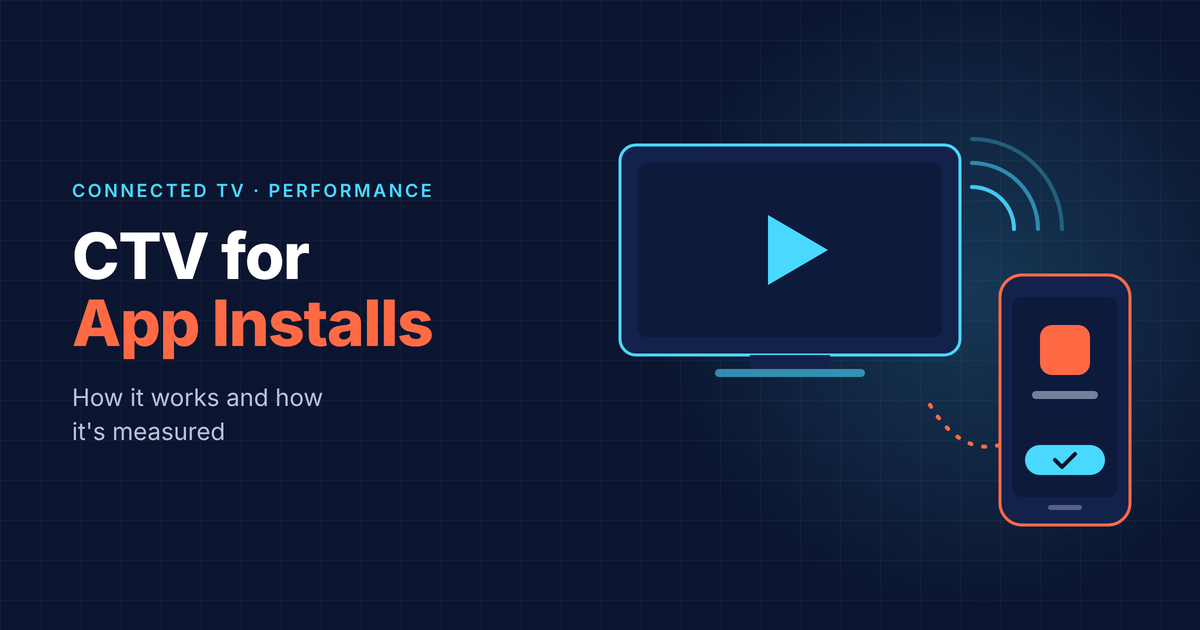
Yes. Someone sees your ad on their TV, picks up their phone and installs the app, often within minutes. Measurement partners like AppsFlyer and Adjust now attribute those installs back to the TV impression, so CTV for app installs can be bought and judged the same way as any other performance channel: on installs, in-app events, and return on ad spend.
For years, that last part was the problem. TV was a brand channel. You bought reach, waited for a lift in organic installs and argued about whether the lift was real. As Alex Yip, Director of Product Strategy at AppsFlyer, put it in September: "TV has historically been a difficult channel for mobile marketers to connect to real business outcomes" (AdTech Radar).
That's changed. Below: the data, how attribution actually works, and how to set up a first campaign without wasting budget.
What the data shows
The money is already moving. IAB's 2026 video ad spend report projects U.S. CTV ad spend to grow 11% this year, with sports rights moving to streaming as one of the drivers (IAB, May 2026). More of the audience you used to reach on linear TV is now on an ad-supported streaming app.
The better question for an app marketer: do CTV users act differently once they install? AppsFlyer's CTV-to-mobile trends report (2023 edition) says yes, and in a useful way:
What AppsFlyer measured: Result: CTV-to-mobile attributions, Feb to Oct 2023: Grew 9x. Apps with higher ARPPU from CTV-to-mobile users than mobile-only installers: 40% of apps. ARPPU uplift in those apps: at least 56% higher on average. Installs (within a 72-hour window) that came in the first hour after the TV ad: about 20%
Two things stand out. Installs come fast, so the TV ad is doing direct-response work, not just softening people up for a later search. And in many apps, users who came from TV pay more. That second number is the one to bring to a budget meeting.
Be careful with it, though. It's 2023 data; it's averaged across apps, and 60% of apps didn't see the uplift. Your own test is the only number that counts.
How CTV-to-mobile attribution works
A TV and a phone share no device ID, so you can't match them directly. MMPs connect the two through the shared network instead.
- The ad runs. A viewer sees your ad on a connected TV. The impression is logged, including the household network's IP address.
- The install happens. Within the attribution window, a phone on that same network installs your app.
- The MMP matches them. AppsFlyer, for example, credits the install to the TV impression only if it happens on a device using the same IP network as the TV exposure, within a probabilistic view-through window of up to 72 hours, 24 by default (PPC Land; AppsFlyer help center).
- In-app events follow. Purchases, sign-ups, and subscriptions flow back to the buying platform, which can then optimize toward them.
Adjust runs its own CTV measurement product, CTV AdVision, and Edge226 is listed as a CTV partner in Adjust's partner directory (Adjust).
One thing to check before you launch: windows differ a lot between platforms. A DSP might count conversions for 30 days while your MMP stops at 72 hours. Agree on which number is the source of truth before the first report lands, or you'll spend the post-mortem arguing about attribution instead of results. (More on why CTV installs often arrive late or land in organic: CTV to Mobile Attribution.)
How to set up CTV for app installs
- Set up CTV measurement in your MMP first. Turn on CTV attribution in AppsFlyer, Adjust, or whichever MMP you use, and confirm impressions are flowing in before any real budget goes out. No impressions in the MMP means no installs get credited, no matter how well the campaign runs.
- Pick one outcome to optimize for. Installs are the easy starting point. If you already know your post-install economics, go straight to a purchase or subscription event. Buying on a downstream event is slower to learn but cuts out cheap, low-value installs.
- Build the creative for a phone that's already in someone's hand. People watch TV with their phone nearby. Show the app, say what it does in one line, and give a reason to install now. A QR code helps, but plenty of people will search the store by name instead, so keep the name on screen long enough to remember.
- Run a holdout. Keep a control group that doesn't see the ads. Comparing exposed and unexposed households is the cleanest way to show that CTV drove installs that wouldn't have happened anyway.
- Judge it on day-7 and day-30 numbers, not day 1. If CTV users pay more, as they did in 40% of apps in AppsFlyer's data, that shows up in revenue per user later. A CPI-only read will undersell the channel.
This is how Edge226 runs CTV: campaigns optimized toward CPI, CPA, and ROAS rather than impressions, with incremental lift measured through your MMP (Edge226 CTV).
FAQ
Can CTV ads drive mobile app installs?
Yes. A viewer sees the ad on a connected TV and installs the app on a phone on the same home network. MMPs such as AppsFlyer and Adjust attribute that install to the TV impression, so CTV can be measured on installs and in-app events.
How is CTV attributed to app installs?
Major MMPs, including AppsFlyer, Adjust, and Singular, match the TV impression and the mobile install using a shared household IP address within a set view-through window. AppsFlyer's maximum probabilistic view-through window for CTV is 72 hours.
Is CTV more expensive than mobile for app installs?
CTV CPMs are usually several times higher than mobile: $4.68 against $1.44 in April 2026, per DataBeat. The fairer comparison is revenue per user: in AppsFlyer's 2023 data, 40% of apps saw higher ARPPU from CTV-to-mobile users than from mobile-only installers.
What is a good attribution window for CTV?
Short enough that the match means something. AppsFlyer defaults to 24 hours for probabilistic CTV view-through and caps it at 72. Longer windows will credit more installs to TV, but with less confidence that the ad caused them.
Test CTV for your app
If you've been holding off on CTV because you couldn't measure it, that reason is mostly gone. Get in touch, and we'll scope a test around the outcome you already report on.